Invoice & Receipt Data Extraction
A Document AI annotation and quality-assurance demonstration built on synthetic invoice and receipt data. We designed the annotation schema, created a controlled synthetic dataset, defined edge-case rules, and designed a blind QA workflow for structured document-extraction training data.
250
Synthetic Invoices & Receipts
10
Header Fields
Line Items
Structured Table Extraction
3
Document Layouts
Label Studio
Annotation Interface
Blind QA
Quality Methodology
The Challenge
High-Precision Document Data Extraction
Organizations building Document AI models require consistently labeled data from invoices, receipts, and financial statements. The challenge is far greater than OCR text extraction—it requires precise field boundaries, normalization of Indian GST tax structures, line-item itemization, and unambiguous handling of unreadable or missing values.
Field Boundaries & Formatting
Capturing exact text tokens and normalizing currency, dates, and numbers.
Line-Item Structure
Extracting description, quantity, rate, and amount per item row.
GST Tax Interpretation
Distinguishing CGST/SGST vs IGST structures and seller vs buyer GSTIN.
Scan Variations & Noise
Handling skewed scans, thermal receipts, shadows, and cut-off values.
Annotation Schema
Header Fields & Line Items
Our annotation guideline establishes explicit rules for 10 key header fields and itemized line-table rows.
10 Header Fields
Line-Item Table Extraction
Line items are recorded top to bottom, one row per item, using a strictly delimited format:
Example Formatted Rows:
Wireless Mouse | 3 | 695.00 | 2085.00
Cotton Waste (kg) | 14.9 | 62.03 | 924.25
Guidelines & Edge Cases
Built for Real-World Document Variation
Seller vs Buyer GSTIN
Extracts the seller's 15-character GSTIN. Buyer GSTINs under 'Bill To' are excluded.
Issue Date vs Due Date
Extracts the document issue date. Converts day-first Indian formats (e.g., 09/06/2026 -> 2026-06-09).
Receipt Timestamps
Extracts date components and ignores time components on receipt slips.
Currency & Number Formatting
Strips 'Rs.', 'INR', and commas. Normalizes all figures to two decimal places.
Discounts & Round-Offs
Discounts are recorded as positive figures. Round-offs are included in the final grand total.
Unreadable & Cut-off Scans
Flagged explicitly as UNREADABLE with annotator notes. Never guessed.
Execution Path
6-Step Annotation & QA Workflow
Dataset Preparation
Creation of 250 synthetic invoice and receipt documents across 3 layout templates and noise levels.
Guideline Design
Creation of Annotation Guideline v1.0 establishing taxonomy, date parsing, and field edge-case decisions.
Annotation
Structured document field and line-item bounding/text annotation inside Label Studio.
Self Review
Annotator pre-submission checklist verification covering field formats and line item totals.
Blind QA Pass
Independent second-pass annotation on a sampled subset without seeing first-pass labels.
Scoring & Guideline Iteration
Automated script scoring against ground-truth answers, error categorization, and guideline refinement.
Quality Control
Quality is Measured, Not Assumed
We evaluate dataset quality using automated scoring tools measuring field-level and document-level accuracy.
QA Methodology Ready
Quantitative accuracy results are published only after human annotation and blind QA rounds are executed.
Structured Export
Sample Output Schema
Illustrative annotation output from the synthetic demonstration dataset.
{
  "vendor_name": "Kaveri Stationers Pvt Ltd",
  "vendor_gstin": "37ZZZZZ1234A1Z5",
  "buyer_name": "Nimbus Labs Pvt Ltd",
  "invoice_number": "MA/25-26/0123",
  "invoice_date": "2026-06-09",
  "subtotal": "36169.85",
  "discount": "1808.49",
  "tax_total": "6185.04",
  "total": "40546.40",
  "tax_type": "IGST",
  "line_items": [
    {
      "description": "Wireless Mouse",
      "quantity": "3",
      "rate": "695.00",
      "amount": "2085.00"
    },
    {
      "description": "Cotton Waste (kg)",
      "quantity": "14.9",
      "rate": "62.03",
      "amount": "924.25"
    }
  ]
}
Dataset Samples
Synthetic Document Gallery
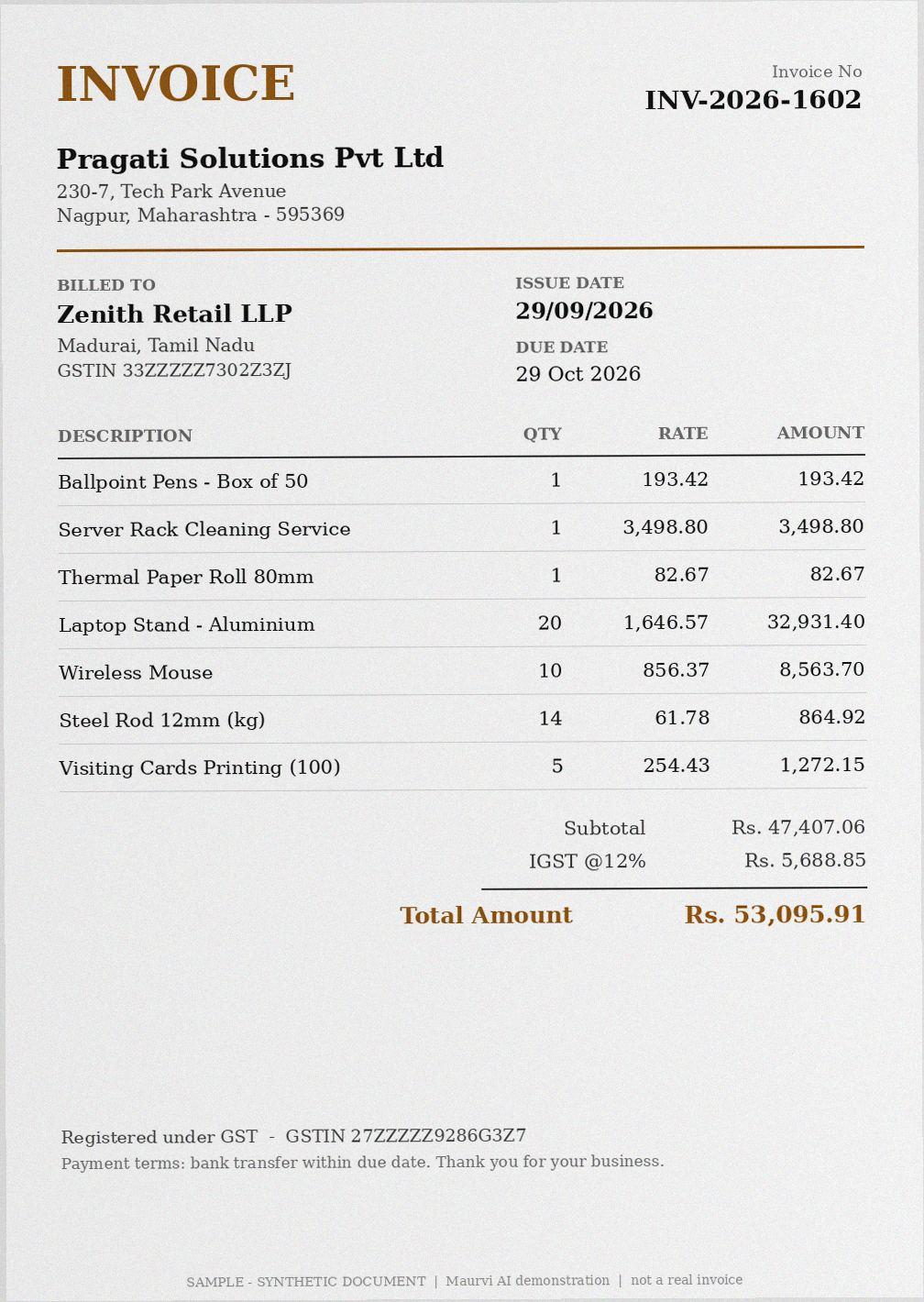
Sample images from the 250 synthetic document dataset showing various layout templates and noise levels.
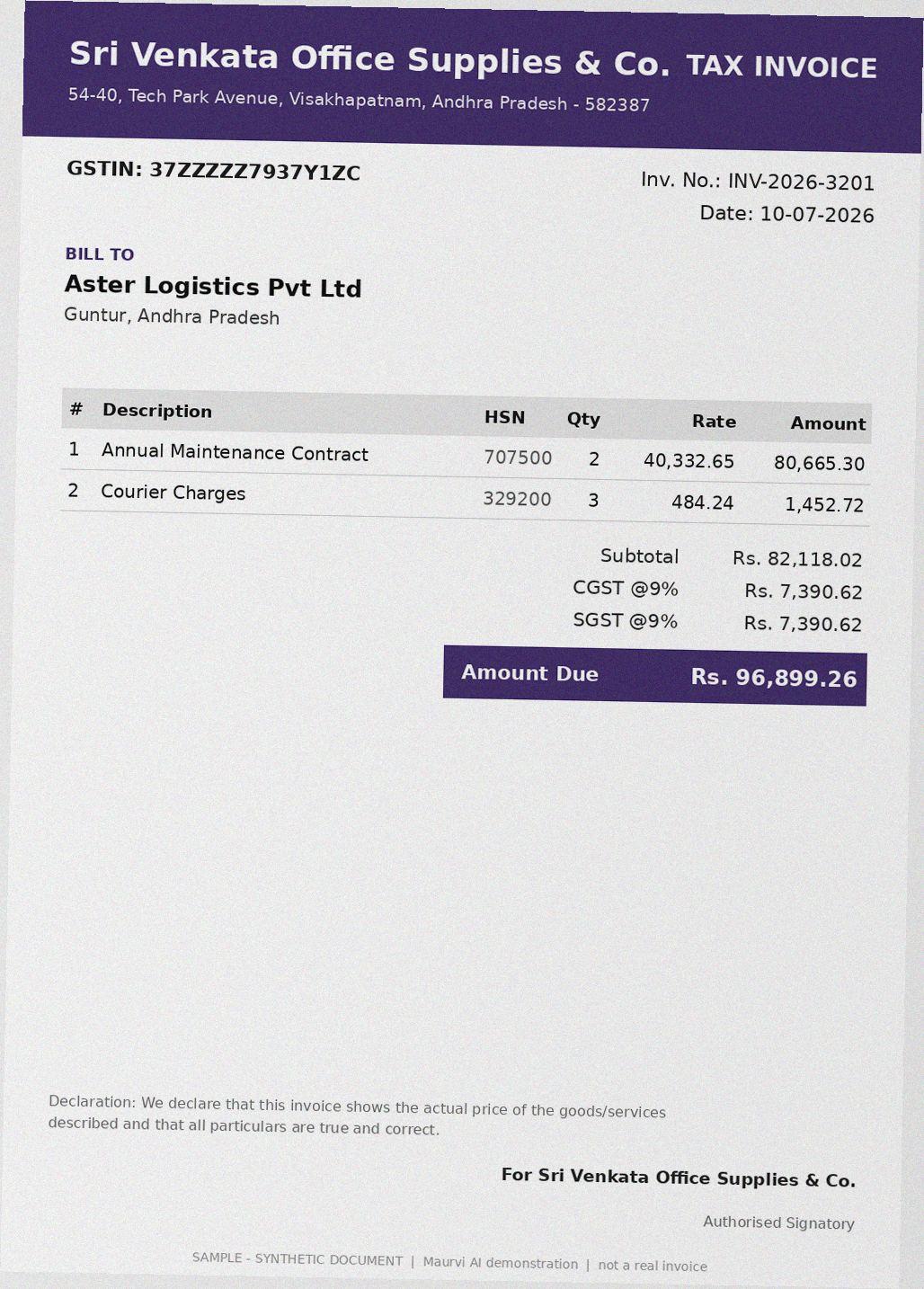
Clean Layout - IGST Structure
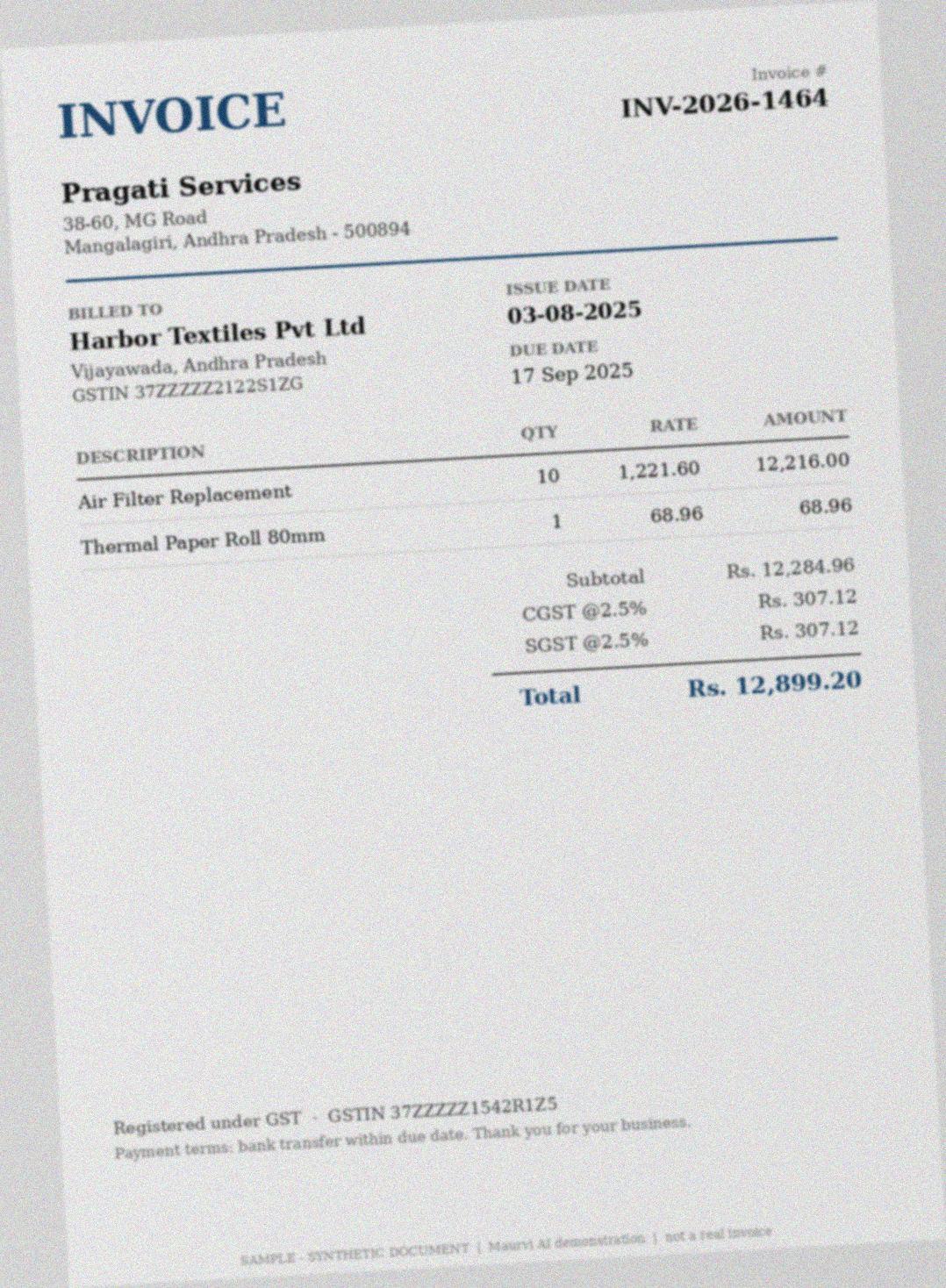
Thermal Receipt Format
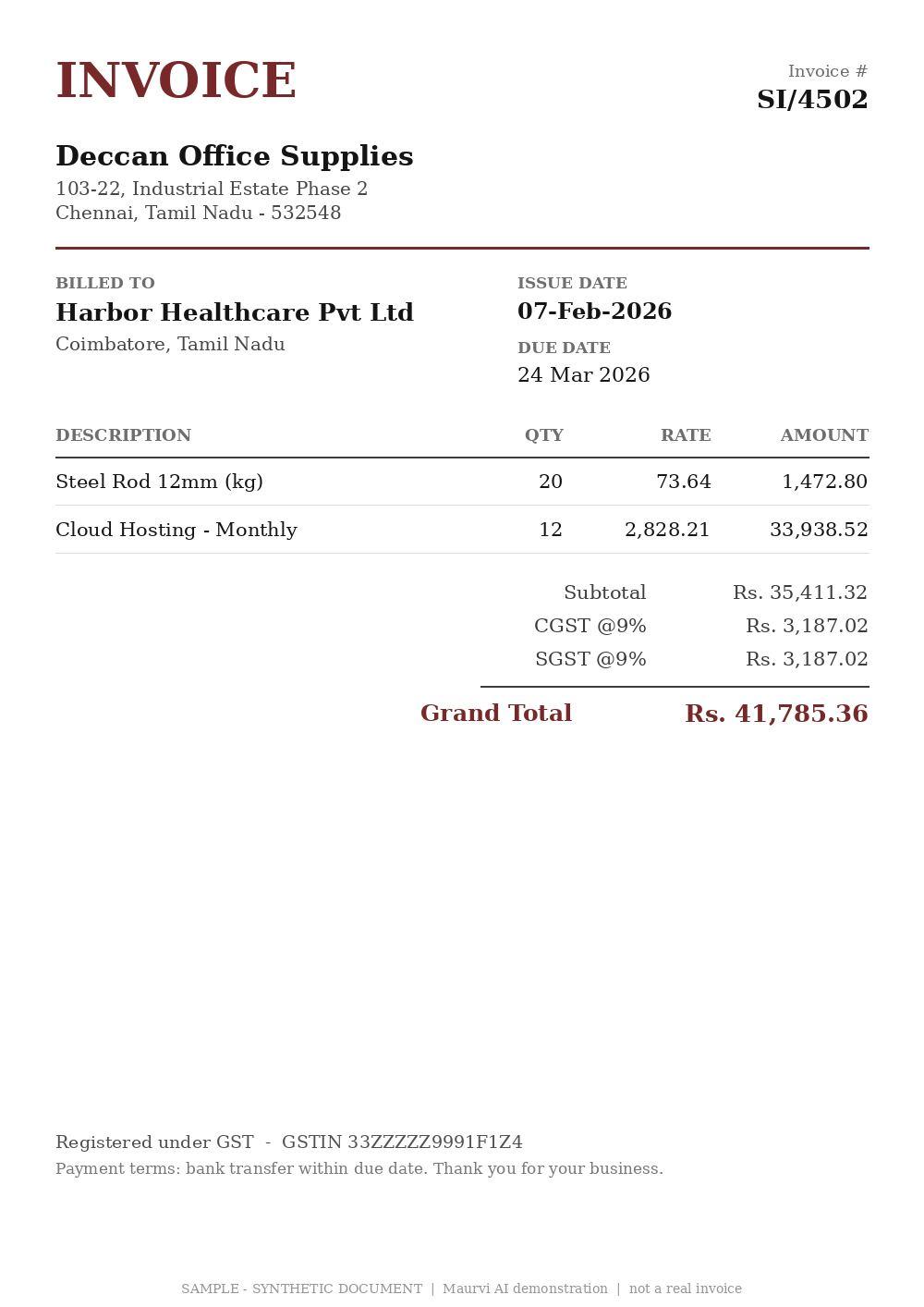
Multi-item Corporate Invoice
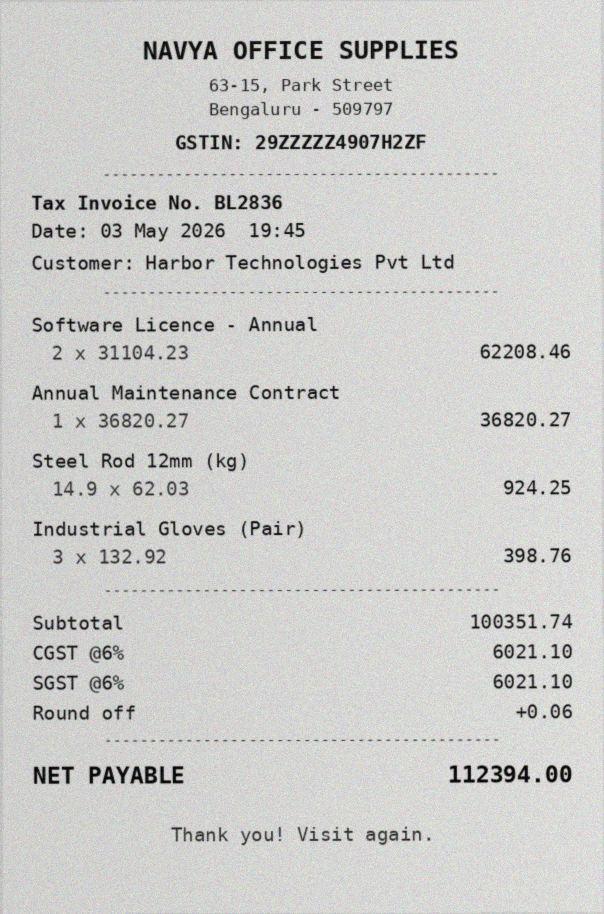
CGST + SGST Breakdown
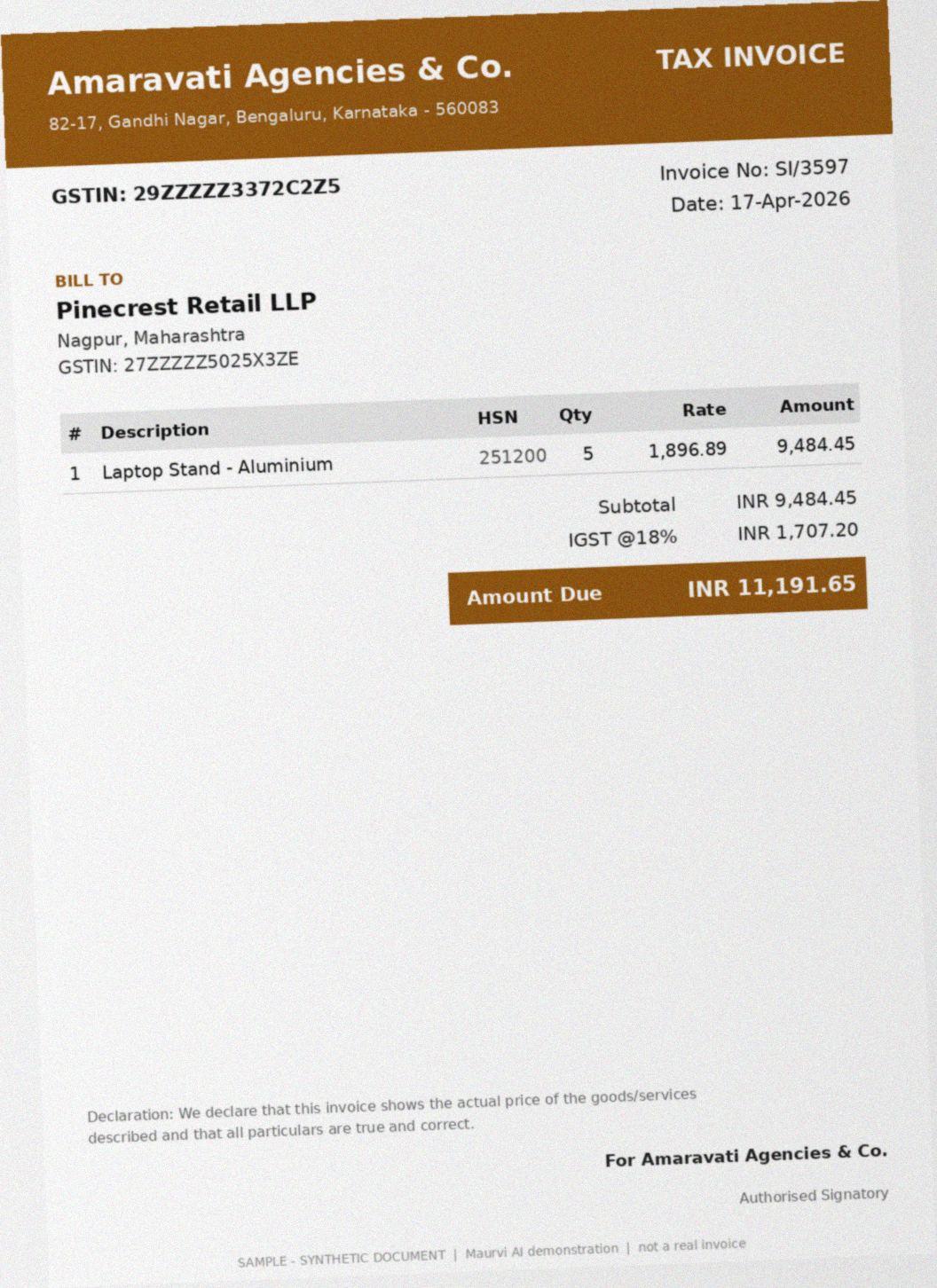
Light Scan Degradation
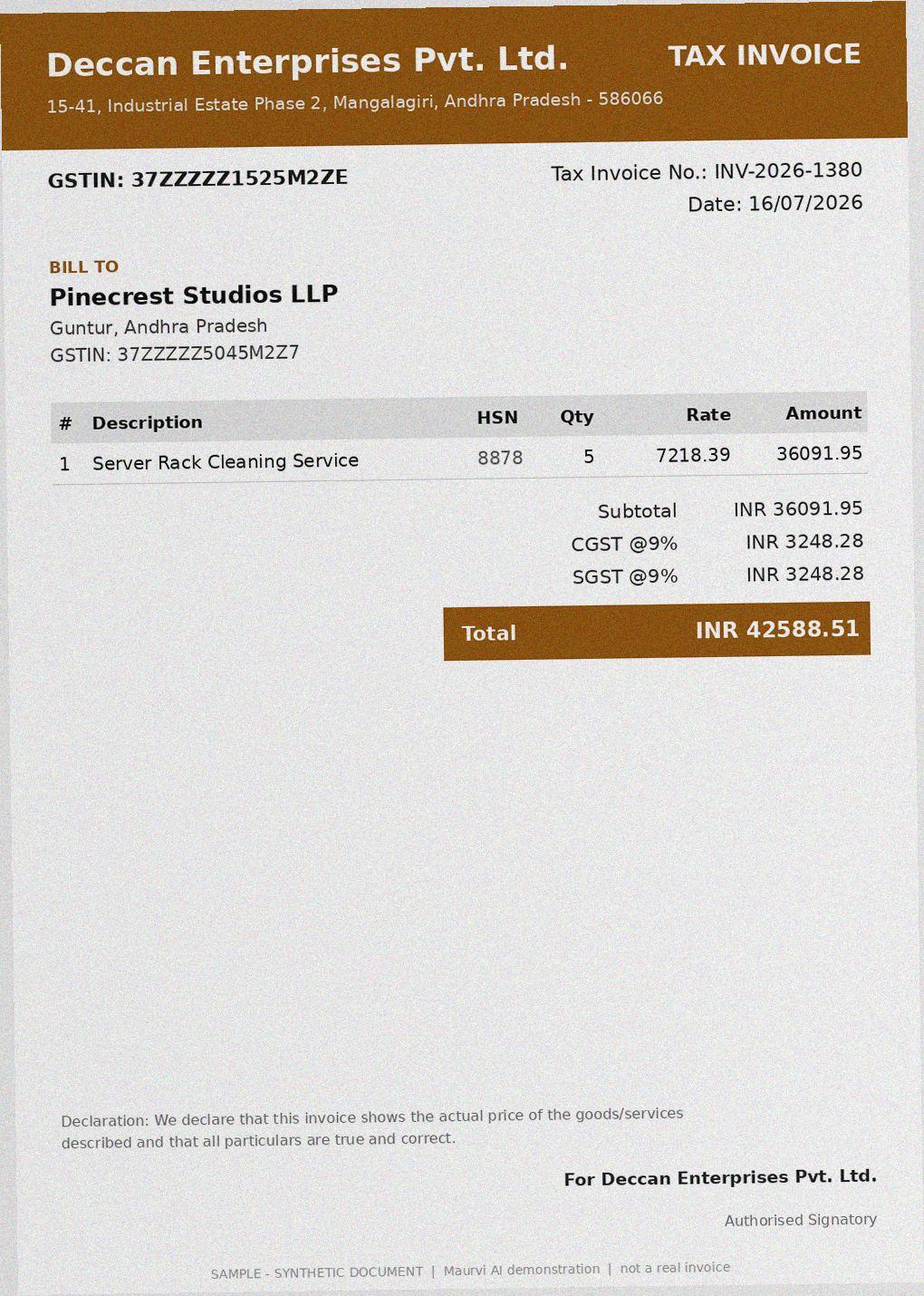
Heavy Noise & Skewed Alignment
Retail Counter Receipt
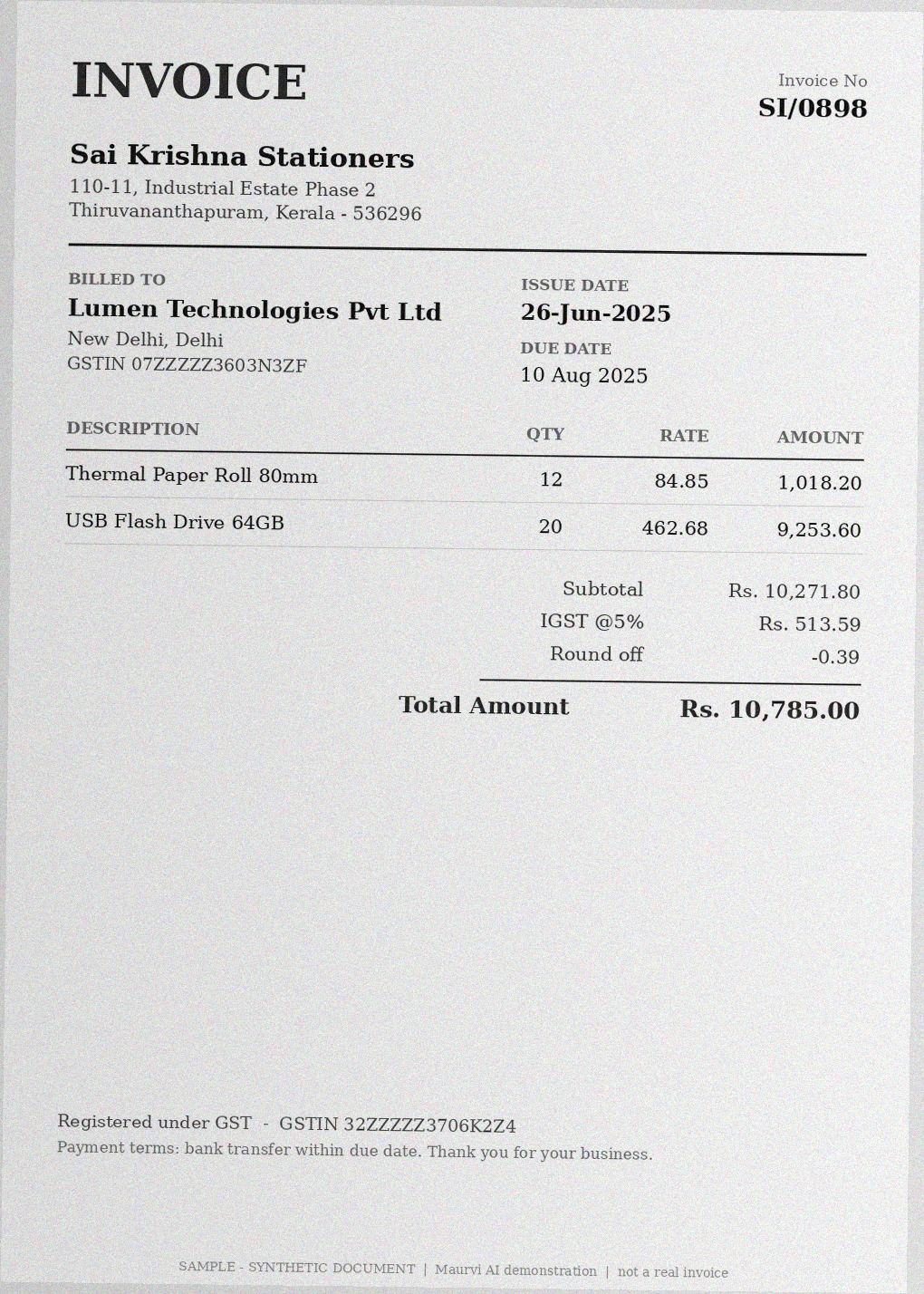
Discount & Round-off Structure
Demonstration Resources
Download Sample Package
Have a similar document-data challenge?
Start with a controlled pilot. We can define the schema, annotate a representative sample, run QA, and deliver structured data in the format your AI workflow requires.